
The short answer
Mavrotragano (Μαυροτράγανο) is Santorini’s rescued red grape — one of Greek wine’s most remarkable comeback stories. Nearly extinct by the end of the 1990s, brought back by Haridimos Hatzidakis and Paris Sigalas and now made by a handful of other producers on Santorini and Tinos, it produces full-bodied, structured, volcanic-terroir reds unlike any others in Greece. Small production, cult status, and — in the very best examples — one of the most compelling arguments for what indigenous grape rescue can achieve.
The grape and its terroir
Mavrotragano — literally “black-crisp” in Greek — is a thick-skinned, deeply coloured red variety with high tannin and high natural acidity. What makes it distinct from every other Greek red is the terroir it defines.
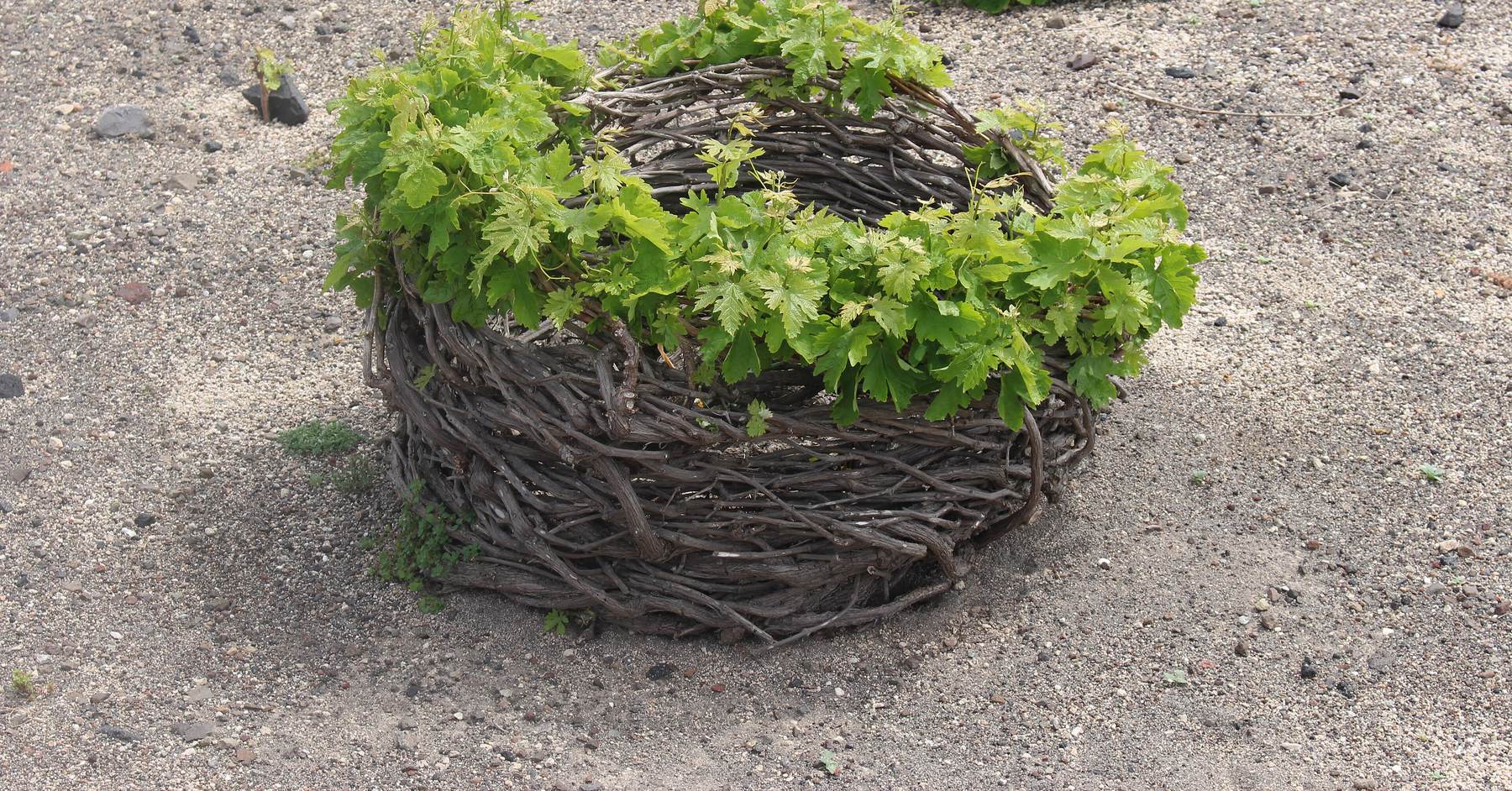
Santorini’s vineyards sit on pure volcanic soil — pumice, ash, and lava — with almost no organic matter. The vines are ungrafted (phylloxera cannot survive in the volcanic material) and typically basket-trained (kouloura), close to the ground, to shelter the grapes from Cycladic wind and sun. Mavrotragano’s own vines are generally younger than the island’s oldest Assyrtiko, since much of the variety has been replanted since its revival.
For Mavrotragano, this terroir produces:
- Concentrated, structured red wines with the same underlying volcanic mineral signature that gives Assyrtiko its distinctive character.
- A smoky-mineral note on the palate that is unique in Greek wine.
- Naturally low yields — a defining feature of ungrafted Santorini vineyards.
- Textural weight despite the light, dry Cycladic climate.
The rescue story
In the early 1990s, Mavrotragano was in serious commercial trouble. As Santorini’s Assyrtiko economy grew — driven by white-wine exports and the emergence of Vinsanto as a fine-wine category — growers had less reason to maintain their rarer red plantings. Yields on Mavrotragano were low, prices were poor, and the variety had essentially fallen out of commercial rotation.
By the end of the decade, only scattered plantings remained.
The turnaround came from two producers. Haridimos Hatzidakis was among the first to bottle a single-varietal Mavrotragano, from the 1997 vintage. Paris Sigalas of Domaine Sigalas was among the first to treat the grape as a serious dry red rather than a curiosity, and his estate became its most prominent champion — which is why his name is the one most associated with it. Other producers followed: Estate Argyros and Gavalas Wines on Santorini, and T-Oinos on neighbouring Tinos, where the variety is grown on granitic soils rather than volcanic ash.
The mainland picked up the story quietly, too: Domaine Gerovassiliou in Epanomi included Mavrotragano as one of the three indigenous grape components (alongside Limnio and Mavroudi) in its flagship red blend, Avaton, giving the variety a role in one of the most internationally recognised Greek red wines.
Today, Mavrotragano is a small but stable category. Plantings remain small — concentrated on Santorini, with a notable presence on Tinos and scattered mainland parcels — but the variety is no longer at risk of disappearing.
What does Mavrotragano taste like?
A well-made varietal Mavrotragano shows:
- Colour: deep ruby to violet, sometimes near-opaque in the top cuvées.
- Aromatics: blackberry, black cherry, damson plum, black pepper, clove, dried herbs (bay leaf, thyme), and a distinctive smoky-volcanic edge that is Santorini’s own.
- Body: full, textural, unusually weighty for a variety grown on such lean soils.
- Tannins: high, firm — but well-integrated in the best examples.
- Acidity: high, refreshing, essential to the wine’s ability to age.
- Alcohol: typically 13.5–14.5% abv.
- Finish: long, savoury, with smoky-mineral notes lingering.
Top-tier Mavrotragano rewards 10 to 15 years in bottle, developing tertiary aromas of leather, dried herbs, smoked meat, and tobacco. It is one of the very few Greek reds — alongside serious Naoussa Grand Reserve — designed to reward long-term cellaring.
International comparisons that recur in wine writing:
- Etna Rosso (Nerello Mascalese) — volcanic mineral, structural
- Northern Rhône Syrah — dark fruit, pepper, smoky
- Aglianico del Vulture — tannin, structure, ageing potential
- Nebbiolo — high tannin and acidity, long-lived
Leading producers
- Domaine Sigalas — the estate most responsible for the modern Mavrotragano category. Its varietal Mavrotragano remains the reference bottling.
- Domaine Hatzidakis — among the first to bottle a single-varietal Mavrotragano (1997 vintage), and still bottles the variety.
- Estate Argyros — a family estate on Santorini since 1903; a 100% Mavrotragano aged around twelve months in 500-litre French oak.
- Gavalas Wines — family estate on Santorini; a quieter name, but consistently rewarding for those who track the variety.
- T-Oinos (Tinos, Cyclades) — Mavrotragano grown on granite terraces in the Rassonas vineyard. Its Clos Stegasta Mavrotragano Rare 2022 was scored 99/100 by James Suckling.
- Domaine Gerovassiliou (mainland, Epanomi) — uses Mavrotragano as one of three indigenous varieties in the flagship Avaton red blend (alongside Limnio and Mavroudi).
At the table
Mavrotragano is a serious dinner-table wine and, in the top vintages, a wine to be treated like Barolo or Etna Rosso — decanted, served with substantial food, and given the space to open up.
Pairings that consistently work:
- Grilled and roasted red meat: lamb (with rosemary and thyme), beef, venison, wild boar.
- Wild game: Mavrotragano is arguably one of Greece’s great game wines.
- Slow-braised dishes: oxtail, osso buco, kokinisto.
- Aged hard cheeses: kefalotyri, aged graviera, parmesan, manchego.
- Greek classics: pastitsio, moussaka, slow-cooked lamb with orzo (giouvetsi).
- For aged Mavrotragano (10+ years): truffle dishes, aged goose, mushroom risotto with truffle oil, cured venison.
How Mavrotragano compares to other Greek reds
| Red | Body | Tannin | Signature | Ageing |
|---|---|---|---|---|
| Xinomavro | Medium | Very high | Tomato, herbs, leather | 15–30 years |
| Agiorgitiko | Medium-full | Soft | Cherry, plum, sweet spice | 5–15 years |
| Limnio | Medium | Moderate | Sage, bay leaf, red fruit | 8–12 years |
| Mavrotragano | Full | High | Dark fruit, spice, volcanic smoke | 10–15 years |
Each occupies its own space. Mavrotragano is the most volcanic and most Cycladic of the four — a wine that could not have been produced anywhere else in Greece.
Why it matters
For collectors and serious Greek-wine drinkers, Mavrotragano is one of the most compelling cult finds in modern European wine — small production, striking terroir, real ageing potential, and a rescue story that adds narrative depth to the tasting.
For the broader Greek wine story, Mavrotragano is proof that the country’s indigenous varieties are still being discovered and rebuilt. Three decades ago it was close to disappearing. Today it is sought out by collectors and critics as a serious red in its own right — a Santorini wine that invites comparison with Barolo, Hermitage or Etna.
For a wider context on the island that produced it, see our Santorini Wine: A Complete Guide.
Find the perfect Greek wine for what you’re eating
Use e-SOM, our digital sommelier, to pair Greek wine with your food — or even with your mood. Free, fast, available in English and Greek.
See also: Santorini Wine: A Complete Guide · What Is Assyrtiko? · Seven Greek Wineries Every Wine Lover Should Know · Producer Profile: Domaine Gerovassiliou