
The short answer
Assyrtiko is an indigenous Greek white grape variety, grown for centuries on the volcanic island of Santorini. It is defined by searing natural acidity, a distinctive saline-mineral character, and the rare ability — for a white wine — to age gracefully for 10 to 20 years. It is produced in both bone-dry styles and the historic sweet Vinsanto, and it is now widely recognised as one of the most important white wines of the Mediterranean.
Where does Assyrtiko come from?
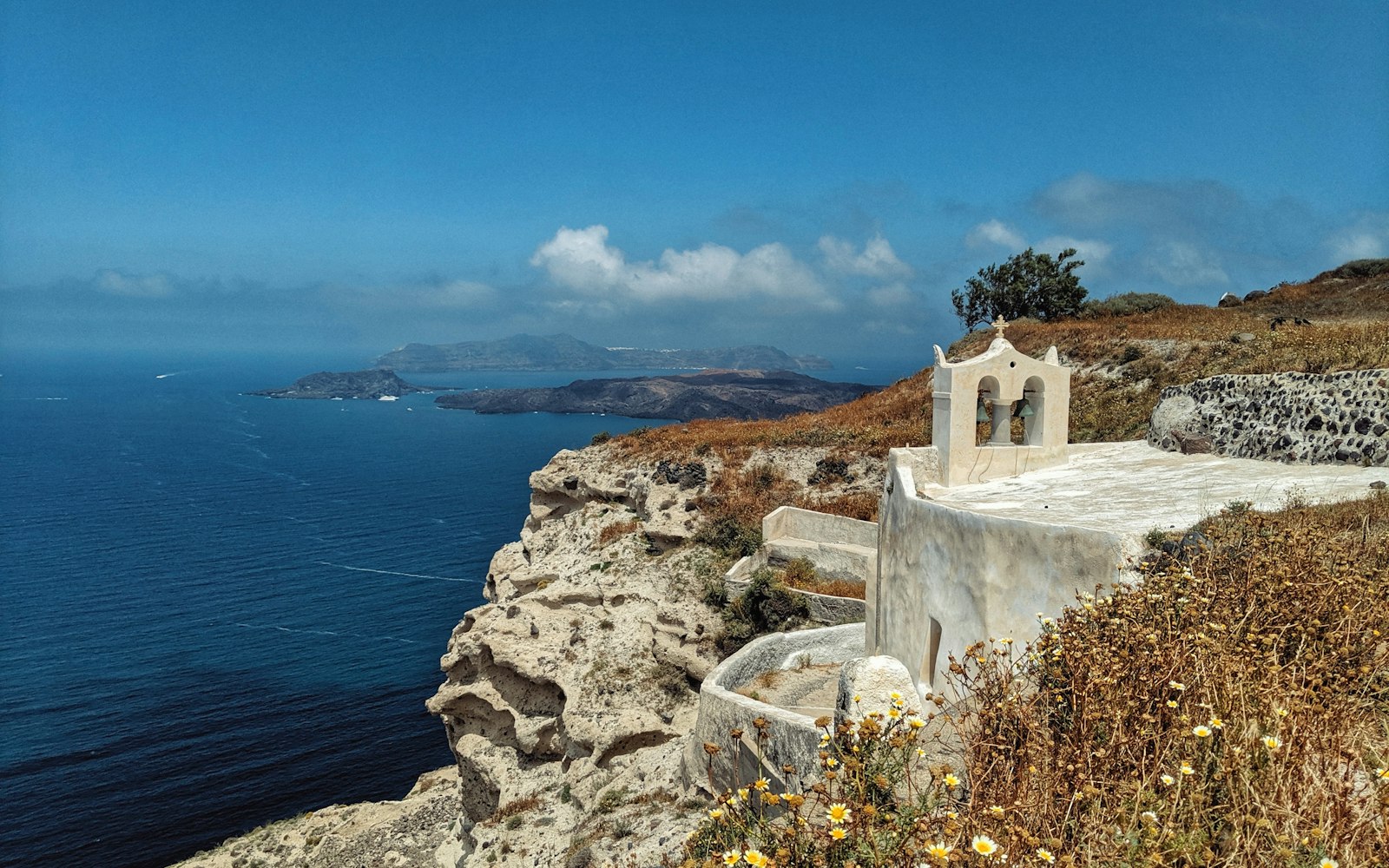
Assyrtiko’s spiritual and commercial home is Santorini, where the variety has been cultivated for thousands of years on the caldera rim and the island’s southern and western slopes. Three factors make this terroir unlike any other in the wine world:
- Pure volcanic soils of pumice, ash and lava — locally called aspa — with almost no organic matter. The phylloxera louse cannot survive in them, which is why Santorini’s vineyards are among the very few in Europe still planted on ungrafted vines, many more than a century old.
- Brutal Aegean winds and intense summer sun, which on most sites force everything to grow close to the ground.
- No surface water. The vines depend on overnight humidity captured from the morning mist.
To survive these conditions, growers train each vine into a low basket — the kouloura — that nests on the ground. The basket shelters the grapes from wind, sun and salt spray, while the exposed canes catch moisture from the morning fog. It is one of the oldest continuously practised pruning systems in the wine world, and visually unlike any other vineyard you will see.
Beyond Santorini, Assyrtiko is now established in Northern Greece — most notably in the PGI Drama vineyard area of Eastern Macedonia and on the Halkidiki peninsula — as well as on Paros, in Attica, and increasingly outside Greece, particularly in Australia (McLaren Vale and Clare Valley). Santorini, however, remains the benchmark by which all other Assyrtiko is judged.
What does Assyrtiko taste like?
A classic dry Santorini Assyrtiko shows:
- Acidity: among the highest in European white wines — taut, mouth-watering, almost incisive.
- Aromatics: lemon and lime peel, white-fleshed apple, citrus blossom, a flash of white pepper, and a pronounced flinty, salty, “wet stone” minerality drawn from the volcanic soil.
- Body: medium to medium-full, with surprising weight for a variety so high in acid.
- Finish: long, dry and saline — what many tasters describe simply as “tasting of the sea.”
With age, the citrus and stone-fruit notes evolve toward beeswax, dried herbs, and the petrol-like nuances familiar from mature Riesling, while the saline-mineral core deepens. Very few white wines in the world transform so dramatically in the cellar.
What styles of Assyrtiko exist?
- Dry, unoaked Assyrtiko — the most common style, fermented and aged in stainless steel to preserve precision and salinity.
- Oak-aged and Wild Ferment Assyrtiko — fermented with indigenous yeasts and aged in barrel; broader and more textural, with citrus oils and toasted nut notes.
- PDO Santorini Nykteri — a traditional late-picked style, by regulation aged in oak; richer and more powerful, often touching 14% alcohol.
- PDO Santorini Vinsanto — a historic sweet wine made from sun-dried Assyrtiko grapes (with permitted small additions of Aidani and Athiri). The wine is aged in oak — the PDO sets a minimum of 24 months, and producers may also label their wines with “4-year,” “8-year,” “12-year” or longer ageing indications, with some Vinsantos aged for 40 years or more. The result is an amber wine of remarkable density, with dried apricot, fig, candied citrus peel, caramel and salted nuts — and, again, electric acidity holding everything in balance.
How does Assyrtiko pair with food?
Few whites are as gastronomically versatile. The combination of weight and acid makes Assyrtiko a natural with:
- Grilled white fish — sea bream, sea bass, sardines.
- Raw shellfish and seafood — oysters, sea urchin, mussels, crudo.
- Seafood risotto and lemon-driven pasta dishes.
- Greek feta PDO (sheep / sheep-goat) or fresh goat’s cheese, brined olives and citrus-dressed salads.
- Sushi and sashimi — particularly with white fish and salt-cured preparations.
- Mediterranean mezze built on lemon, olive oil and fresh herbs.
For specific bottle recommendations matched to your dish, try our e-SOM Digital Sommelier.
Assyrtiko from Santorini: the leading producers
In the variety’s homeland, the most consistently celebrated estates include:
- Estate Argyros — exceptional aged Assyrtikos and a long-aged Vinsanto programme.
- Hatzidakis Winery — naturally-leaning, terroir-driven wines.
- Gaia Wines — known internationally for Thalassitis and its Wild Ferment cuvée.
- Boutari — a long Santorini presence across multiple Greek regions.
- Gavalas Winery
- Artemis Karamolegos
- SantoWines — the Santorini growers’ cooperative.
- Domaine Sigalas
- Mikra Thira — the first winery on Therasia, making Assyrtiko from Therasia vineyards (the TERRASEA label).
Assyrtiko beyond Santorini (Greece)
The variety has expanded successfully into other Greek regions:
- T-Oinos (Tinos) — with the iconic Clos Stegasta vineyard; among the highest-rated Assyrtikos outside Santorini, and for some internationally recognised tasters even finer than Santorini’s own.
- Ktima Zafeiraki (Tyrnavos) — Assyrtiko from organic vineyards.
- Wine Art Estate (Ktima Techni Oinou) — Drama.
- Domaine Costa Lazaridi (Drama)
Assyrtiko outside Greece
Thanks to its resistance to drought, heat and phylloxera, Assyrtiko has become an ambassador of climate resilience and is now grown beyond Greece:
- Australia — Jim Barry (Clare Valley): the first Assyrtiko planted in Australia (2012), from cuttings sourced from Estate Argyros on Santorini.
- Italy, Alto Adige — Alois Lageder: a pioneer of the variety outside Greece, within the biodynamic Comet Wines project.
- Lebanon, Bekaa Valley — Château Oumsiyat (Cuvée Membliarus), among the pioneers of Assyrtiko in Lebanon, alongside the Ana Beirut label.
- Israel — Assyrtiko is also cultivated in Israeli vineyards, as part of the variety’s international expansion.
- France — no commercial production yet, but Assyrtiko has been officially included among the experimental varieties for climate-change adaptation (the VitAdapt programme in Bordeaux, under INAO).
What does Assyrtiko cost?
Assyrtiko spans a wide price ladder:
- Entry-level Santorini Assyrtiko (PDO): €12–€18
- Mid-tier / single-vineyard wines: €20–€35
- Premium and aged Assyrtikos: €40–€80+
- Vinsanto (sweet, 500 ml): €25–€60 for current releases, with long-aged bottlings well beyond.
Per gram of vineyard history and per drop of intensity, top Santorini Assyrtiko remains one of the most under-priced fine white wines in the world.
Why does Assyrtiko matter for Greek wine?
Assyrtiko is the variety that put Greek wine back on the international map. The reasons:
- Critical acclaim from outside Greece. Major international voices — Jancis Robinson MW, Karen MacNeil, Wine Enthusiast, Decanter — have written repeatedly about top Santorini Assyrtikos as benchmark whites.
- Genuine ageing potential. Most premium white wines are drunk young; serious Santorini Assyrtikos reward a decade or more in the cellar.
- Pure terroir expression. In a market increasingly attentive to place, the combination of volcanic soil, ungrafted vines and basket-trained vineyards is a story drinkers can actually taste in the glass.
- A single grape, many wines. From bone-dry to lusciously sweet, from crystalline stainless to oxidative oak, Assyrtiko has the stylistic range usually attributed to entire wine regions.
FAQ
How long can Assyrtiko age? Entry-level dry Assyrtikos drink best within 1–3 years of release. Premium single-vineyard Santorini Assyrtikos regularly age beautifully for 10–20 years under correct cellar conditions (12–14 °C, stable humidity, dark).
What is Vinsanto, and how is it different from dry Assyrtiko? Vinsanto is a historic sweet wine of Santorini, made primarily from Assyrtiko (with permitted small additions of Aidani and Athiri). The grapes are sun-dried before fermentation, and the wine is aged in oak — the PDO requires a minimum of 24 months, while many serious examples are labelled with longer ageing indications such as 4, 8 or 12 years, with some aged 40 years or more.
Is Assyrtiko vegan-friendly? Most dry Assyrtikos are vegan-friendly, but this depends on the fining agents each producer uses. Check the back label or the producer’s website if it is important to you.
How should I serve Assyrtiko? Serve dry styles at 8–10 °C (not ice-cold, so that the aromatics open) and aged or oak-aged styles at 10–12 °C. Use a medium-bowled white wine glass; an aged Assyrtiko also benefits from a slightly larger bowl.
Listen and explore further
For deeper conversations on Greek wine, follow The Wine Lovers Podcast or tune in to radio.thewinelovers.gr.