

The short answer
Retsina is Greece’s most traditional wine. It is a dry white, occasionally a rosé, made by adding natural resin from the Aleppo pine (Pinus halepensis) to the must before or during fermentation. The resin is removed once it has done its job, leaving a wine that smells of pine, herbs and citrus. The main grape is Savatiano, with Roditis in a supporting role, and the classic home of the style is Attica, especially Mesogia, just east of Athens. Long dismissed as cheap taverna wine, retsina is now in a genuine revival. In 2024 a retsina won Best in Show at the Decanter World Wine Awards for the first time.
What makes a wine a retsina
Retsina is defined by one step in the cellar. Natural resin from the Aleppo pine is added to the fermenting must, and Wines of Greece sets the maximum at 1 kg of resin per hectolitre. After it has passed its aroma to the wine, the resin is taken out. Most retsina is white. A small amount is made as rosé.
Retsina also has a special legal status. Only retsina produced in Greece may carry the indication Traditional Designation, a status it shares with the island wine Verdea. On top of that, specific areas have their own geographical indications. Retsina of Pallini, for example, has carried a geographical indication since 1979 and is today a PGI.
Thousands of years of pine and wine
Retsina is far older than the modern wine trade. The ancient Greeks called it retinitis oenos, “resinated wine”, and Wines of Greece notes that it has been made continuously for thousands of years. The resin had very practical uses long before anyone thought of it as a flavour.
- Sealing amphorae. Resin closed the mouths of the clay vessels used to store and ship wine, and coated their insides to keep air out.
- Preserving the wine. It acted as a preservative in a world without modern hygiene.
- Local supply. Many vineyards, especially in Central Greece, grew right next to resin-producing pine forests.
- Aroma. Over time people came to love the scent it gave the wine, and that is the only reason it is still used today.
In the second half of the 20th century retsina’s image suffered. Mass production turned it into an industrial product, and writer Grigoris Kontos Dip WSET notes that it had been a respected wine before social and historical changes after the Second World War and the Greek Civil War made it less appealing. For decades “retsina” was shorthand for cheap, harsh wine served by the jug.
The grapes and the regions
Savatiano is the grape of retsina, and Wines of Greece notes its dominance in Attica, where long tradition has shaped characterful, food-friendly retsinas. Roditis is the second traditional variety, and the retsina PGIs of Attica, Evia and Boeotia permit both. Some modern producers have gone further. Kechris makes its most celebrated retsina from Assyrtiko, the great white grape of Santorini (read more in our guide to Assyrtiko).
Retsina can be made anywhere in Greece, but only some areas may name themselves on the label. According to Wines of Greece, Attica, Evia and Boeotia in Central Greece are home to 15 retsina PGIs. Among them are these.
- PGI Retsina of Attiki
- PGI Retsina of Mesogia
- PGI Retsina of Koropi
- PGI Retsina of Markopoulo
- PGI Retsina of Pallini
- PGI Retsina of Gialtra (Evia)
- PGI Retsina of Viotia
Mesogia, the plain east of Athens around Markopoulo, Koropi, Spata and Pallini, is the historic heart of the style.
What retsina tastes like
Good retsina is a balance between the grape and the pine. Wines of Greece describes the hallmark aromas as pine, sage, rosemary, mastic and ginger, woven into the natural fruit of the grape. In the best examples the balsamic pine note does not hide the grape’s own aromas, and a very slight bitterness gives the finish a refreshing lift.
The modern style is lighter on resin than the taverna retsina many visitors remember. Producers now use fresh resin, in smaller amounts, on better grapes, and the result is a crisp, aromatic white with citrus and herbs rather than a wine that tastes of pine alone.
The retsina revival
The turnaround started in the 1980s and has gathered pace ever since. Wines of Greece credits a new generation of producers who approached retsina with respect for tradition and modern technical skill, using higher-quality grapes, more restrained resin and refined winemaking.
The moment the wider wine world noticed came in 2024. Kechris Tear of the Pine Retsina 2022 scored 97 points and won Best in Show at the Decanter World Wine Awards, the first retsina ever to do so. It was one of only 50 Best in Show wines out of 18,143 entered. Decanter’s co-chair Andrew Jefford admitted that eyebrows were raised every time the wine was tasted.
The producers to know
Kechris (Thessaloniki). The family winery most associated with retsina’s revival. Its flagship Kechribari, sold in a distinctive 500 ml bottle, has been made by the family since 1939, and according to the winery it became the first retsina to win an award at an international wine competition, in the late 1990s. Stelios Kechris, who studied oenology in Dijon and took up the cause of retsina in the early 1980s, went on to create Tear of the Pine, which the winery describes as the first retsina made from Assyrtiko and vinified in oak barrels, and the only retsina with the potential to age. The grapes come from Goumenissa in northern Greece.
Domaine Papagiannakos (Markopoulo, Attica). A benchmark for classic Attica retsina. The estate’s Retsina is 100% Savatiano from 70-year-old, non-irrigated vines on limestone in south-east Attica, labelled Traditional Appellation Mesogia. The resin comes from selected pine trees of East Attica and is added during fermentation. The estate recommends serving it at 9 °C.
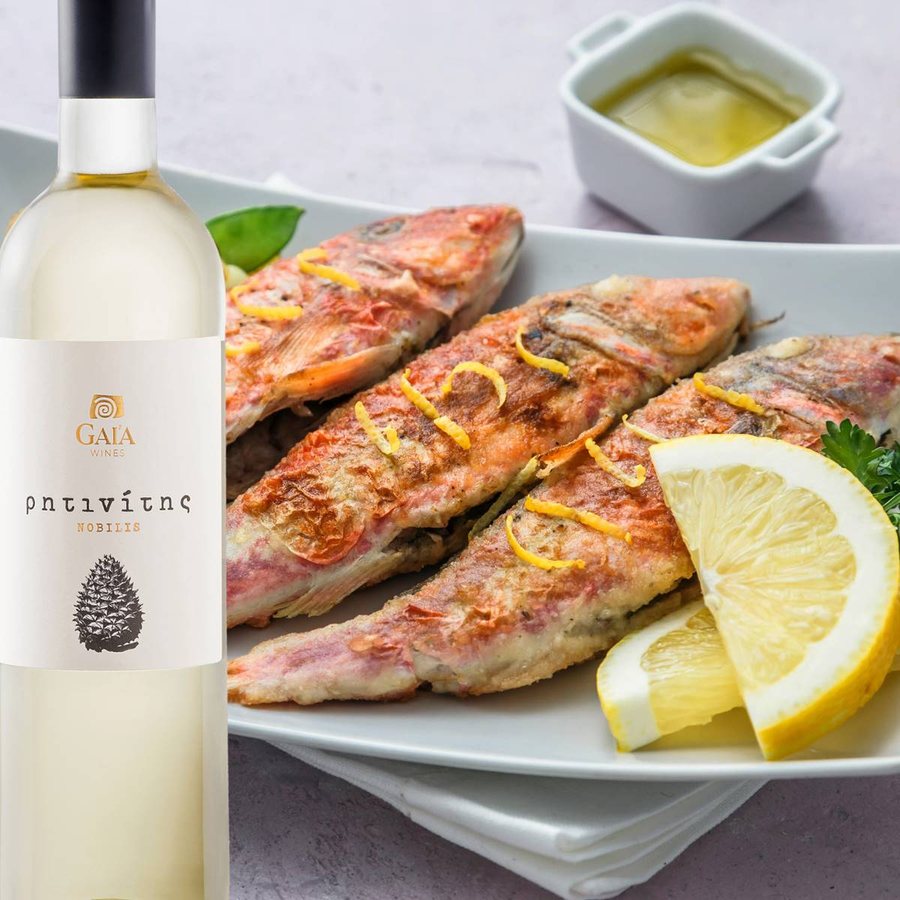
Gaia Wines (Nemea). Ritinitis Nobilis is Gaia’s take on a premium retsina, made from low-yielding Roditis grown on the hills around Nemea, in Corinthia, with a carefully calculated amount of Aleppo pine resin. Gaia describes the result as citrus and pine “on equal terms”. If you know Gaia from its reds, see our guide to Nemea.
Retsina at the table
Retsina was made for food, and Wines of Greece calls it one of the most food-friendly wines not only in Greece but in the world. Its intensity copes with dishes that defeat most whites.
- Fried seafood. Calamari, whitebait, sardines and fried red mullet are classic partners. The pine and acidity cut through the oil.
- Cured and raw fish. Taramosalata, cured anchovies and raw seafood.
- Salty and spicy cheeses. Feta, spicy cheese spreads and fried saganaki.
- A table of meze. Retsina is at its best with many small plates at once, the way Greeks actually eat.
For more ideas see our guide to Greek whites for fish and our wine pairings for Mediterranean cuisine. To match a specific dish, try e-SOM, our free digital sommelier, built on expert knowledge of Greek wine and food.
Serving. Serve retsina well chilled, at around 9 °C. Most retsina is made to be drunk young and fresh. Oak-aged examples such as Tear of the Pine are the exception and can develop in bottle.
Read next
Sources. Wines of Greece (winesofgreece.org) articles on Retsina and “Retsina, from Tradition to a New Era”, and its PGI Retsina pages; Decanter, DWWA 2024 coverage; Grape Magazine (grapemag.gr), “Kechris, Retsina, Updated” (2024); producer pages of Kechris (kechris.gr), Domaine Papagiannakos (papagiannakos.gr) and Gaia Wines (gaiawines.gr).