
The short answer
Athiri (Αθήρι) is an ancient white grape of the Aegean Sea, used for centuries to make dry white wines. It is the lead white variety of PDO Rhodes and PDO Slopes of Meliton in Halkidiki, and one of the two grapes allowed alongside Assyrtiko in PDO Santorini. In the glass it is the gentle counterpoint to Assyrtiko: citrus and white fruit, soft acidity, moderate alcohol, medium body, best drunk young and cool, ideally on a warm day with simple food.
The grape
Athiri is a white variety native to the Aegean. Wines of Greece describes it as an ancient white grape variety of the Aegean Sea, well suited to arid, warm island conditions and able to perform across a wide range of soils. The Oxford Companion to Wine associates it above all with Rhodes and notes its lemon character. You may also see it under local synonyms such as Asprathiri or Athiri Lefko (“white Athiri”).
What defines Athiri is restraint. It does not have Assyrtiko’s piercing acidity or Malagousia’s perfume. Its wines show:
- Aromatics: moderate intensity — lemon and other citrus, white and yellow fruit.
- Acidity: soft, but enough to keep the wine fresh and lively.
- Body: medium.
- Alcohol: moderate.
That gentle profile is exactly why it has survived for centuries in Aegean vineyards: it makes easy, refreshing whites in hot, dry places, and it softens blends built on sharper grapes.
Where Athiri grows
Rhodes — the island of Athiri
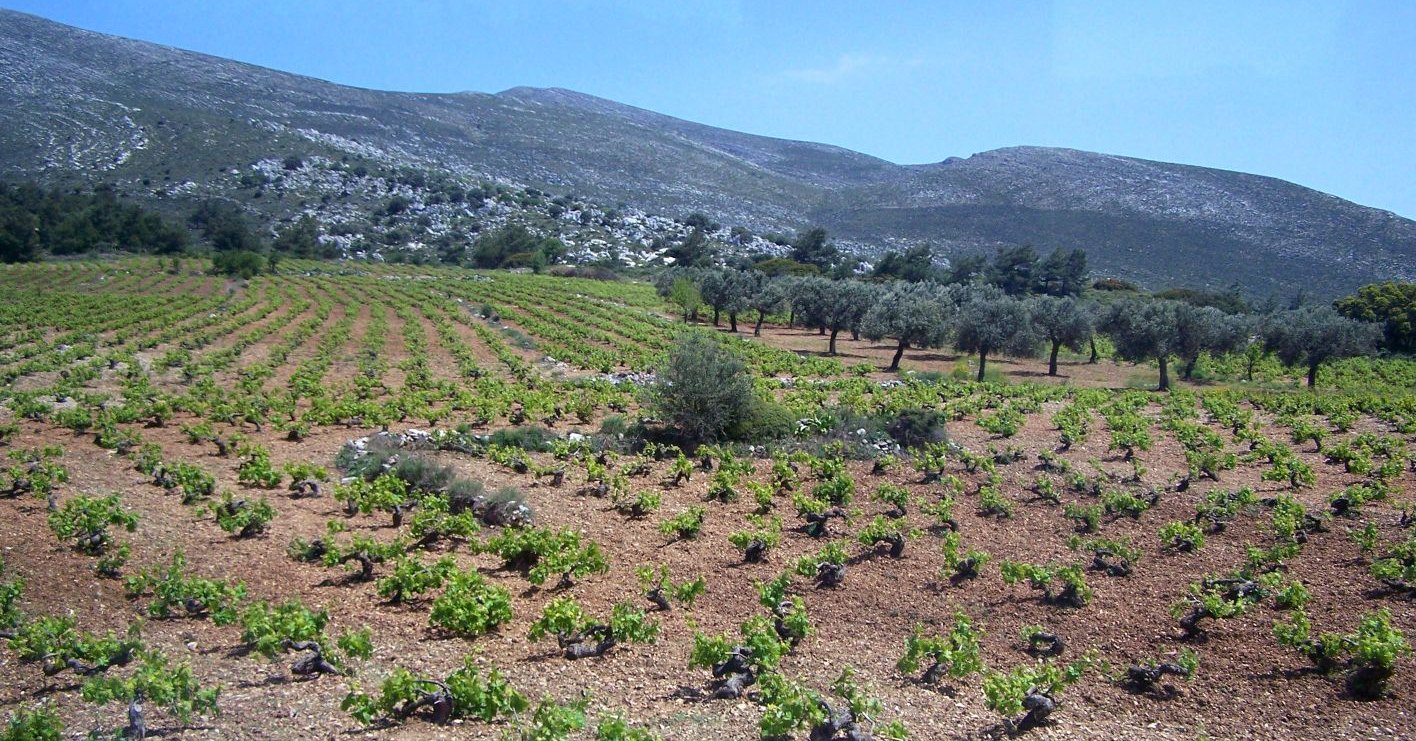
Rhodes is where Athiri leads. Under PDO Rhodes, the white wine must be made from at least 70% Athiri, with Assyrtiko and Malagousia allowed in the balance. The best Athiri on the island is grown at mid-to-high altitude on the slopes of Mount Atavyros — around Embonas, Agios Isidoros, Kritinia, Lakki, Monolithos and Sianna — with the official PDO file placing the vineyards up to 650 metres. Wines of Greece notes that Athiri gives its top results in these high vineyards. Rhodes also makes sparkling wines under its PDO.
Halkidiki — Athiri at the heart of PDO Slopes of Meliton
On the Sithonia peninsula in Halkidiki, Athiri is the backbone of PDO Slopes of Meliton, established in 1982. The white wine is an Athiri-led blend with Roditis and Assyrtiko. The appellation is unusual: Wines of Greece notes that the zone practically belongs to a single owner, so the PDO’s wines come from one winery — Domaine Porto Carras.
Santorini — the supporting role
On Santorini, Athiri plays second fiddle. Since the rules were amended (published by the EU in 2022), dry white PDO Santorini must contain at least 85% Assyrtiko, up from 75%; the remainder may be made up of Aidani and Athiri. Many producers now bottle 100% Assyrtiko, so Athiri appears only in some blends. It is also one of the permitted grapes in Santorini’s sweet Vinsanto — see our guide to Greek dessert wines.
Crete and the wider Aegean
Wines of Greece also lists Athiri, in small percentages, in the Cretan PDOs Handakas-Candia, Malvasia Sitia and Malvasia Handakas-Candia, and as a grape grown throughout the Aegean islands.
Athiri versus Assyrtiko
The two grapes share Santorini’s vineyards but behave very differently:
| Assyrtiko | Athiri | |
|---|---|---|
| Acidity | High, piercing | Soft |
| Structure | Firm, mineral | Gentle, medium-bodied |
| Aromatics | Citrus, saline, flint | Citrus, white and yellow fruit |
| Ageing | Built to age | Best young |
That contrast is the reason Athiri earned its place in Aegean blends: it softens and rounds, while a sharper partner supplies the backbone. For the full story of its more famous partner, see What Is Assyrtiko?.
Does Athiri age?
Mostly, no — and it isn’t meant to. Wines of Greece advises drinking Athiri young, within two to three years of the vintage. It also notes that some examples tasted at around five years turned out delicate but complex, so a good bottle can hold for a few years. Buy it to drink, not to cellar.
Producers to know
Four bottles show Athiri in four different roles — from the whole wine to a small part of the blend.
Rhodes — Athiri on its own
- CAIR (Rhodes) — Ilios de Rhodes, PDO Rhodes, 100% Athiri. The grapes come from semi-mountainous vineyards around Embonas, Siana and Monolithos at 300–500 metres, on clay-sandy, stony soils. The winery describes ripe yellow fruit (banana, apple, pear), a subtle note of white flowers, moderate-to-high acidity and a long finish, and suggests it with white meat, fish and light cheeses.
Halkidiki — Athiri leading the blend
- Domaine Porto Carras (Sithonia, Halkidiki) — the single producer of PDO Slopes of Meliton. Its Slopes of Meliton white is 50% Athiri, 35% Roditis and 15% Assyrtiko. The estate describes bright lemon colour, stone and tropical fruit with hints of brioche, crisp acidity balancing a full body, and good length — and suggests it with pasta in white sauces, poultry, oily fish and aged cheeses.
Santorini and the Cyclades — Athiri as Assyrtiko’s partner
- Domaine Sigalas (Santorini) — Aa, PGI Cyclades, an Assyrtiko–Athiri blend from vines over 60 years old on Santorini and other Cycladic islands, aged six months on its lees in tank. The estate describes a restrained nose of subtle stone fruit with mineral and delicate floral notes, a medium body, vibrant acidity and a persistent finish.
- Santo Wines (Santorini) — Santorini Nykteri, PDO Santorini: 85% Assyrtiko, 10% Athiri, 5% Aidani. In the traditional nykteri way, the grapes are pressed the night after harvest. The winery describes jasmine, green apple and pear on a vanilla background, with crisp, refreshing acidity and a long finish.
At the table
Athiri’s lean, gentle structure makes it a useful wine for dishes that are hard to match. In Greece it is often poured as an aperitif, especially at long summer lunches. Pairings that work:
- Lightly cooked fish and seafood: grilled sardines, sea bream, raw or lightly cured fish — see our best Greek whites for fish.
- Mezze: fava, taramosalata, grilled vegetables with olive oil and lemon.
- Fresh and soft cheeses: feta, manouri, young graviera.
- Vegetable dishes: gemista, briam, horta with lemon.
- Light poultry: chicken with lemon and oregano.
Serve it well chilled, around 8–10 °C.
Why it matters
Athiri is a reminder that not every Greek grape is a star or a comeback story. Some have simply kept doing their job, quietly, for centuries: making fresh, easy whites in the hot, dry Aegean, and softening the blends of sharper grapes. On Rhodes and on the Slopes of Meliton, it still takes the lead role.
For more on the island where it plays its best-known supporting part, see our Santorini Wine: A Complete Guide.
Find the perfect Greek wine for what you’re eating
Use e-SOM, our digital sommelier, to pair Greek wine with your food — or even with your mood. Free, fast, available in English and Greek.
See also: Santorini Wine: A Complete Guide · What Is Assyrtiko? · Best Greek White Wines for Fish · How to Read a Greek Wine Label