
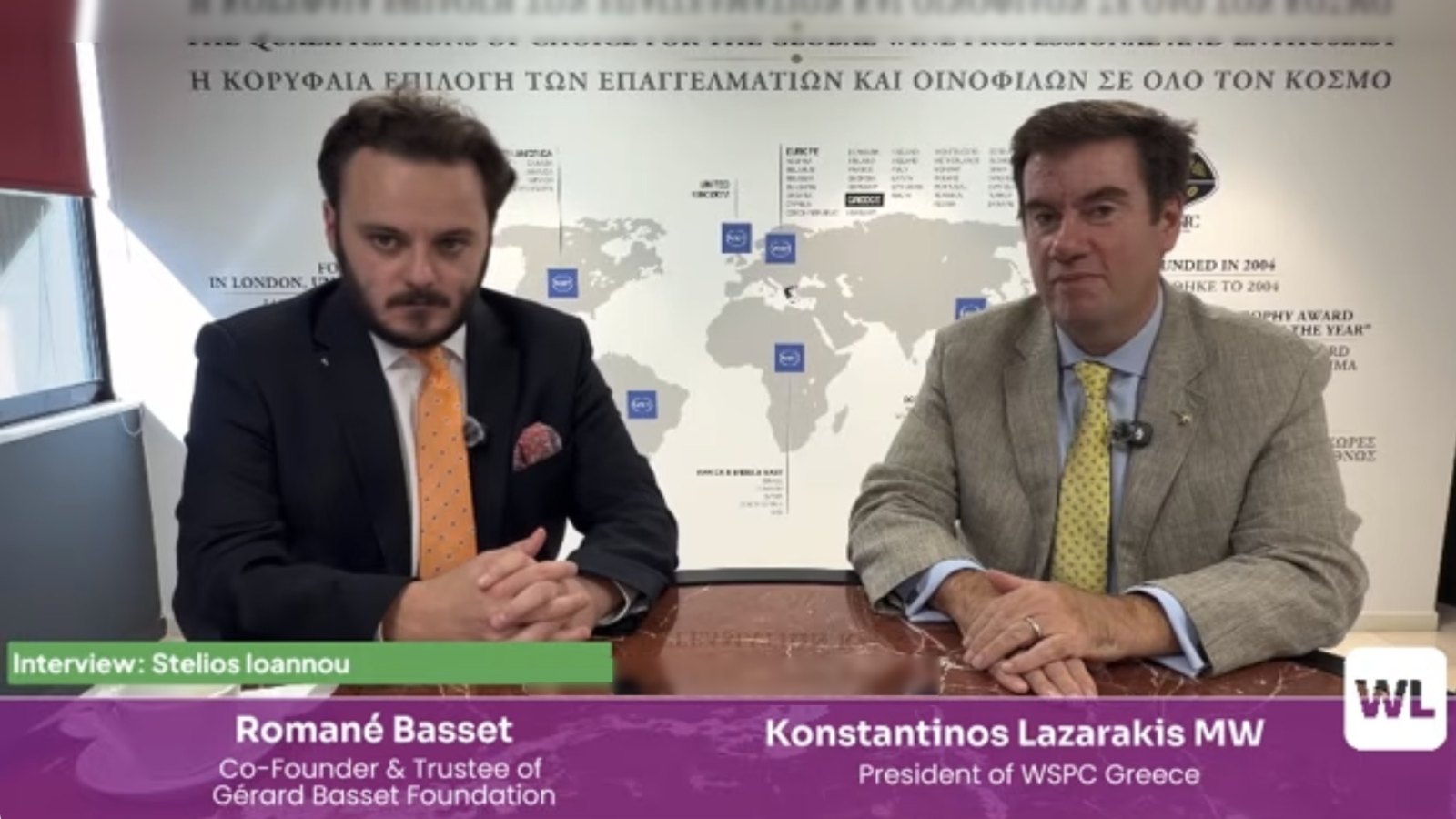
Romané Basset and Konstantinos Lazarakis MW on the Gérard Basset Foundation–WSPC programme that gives unemployed young Greeks a free start in wine, spirits and sake
The Gérard Basset Foundation, the charity set up in memory of the French-born British sommelier who held the titles of Master of Wine, Master Sommelier and OBE, has chosen Greece again. After three years of funding wine education for single mothers through the Wine Spirits Professional Center (WSPC) in Athens, the Foundation has once more pledged two years of funding for a new programme, offering free WSET qualifications in wine, spirits and sake for registered unemployed Greeks aged 18 to 32.
On the day the partnership was presented in Athens, The Wine Lovers Greece sat down with Romané Basset, co-founding trustee of the Foundation and son of the late Gérard Basset, and Konstantinos Lazarakis MW, president of WSPC and the first Greek to earn the title of Master of Wine. The conversation moved from grant criteria to Andreas Papandreou, from a gin distillery in Hampshire to dog walks spent reciting the Grand Cru villages of the Côte des Blancs, and also to why, seven years after Gérard’s death, the Foundation refuses to be a conversation about “what a great guy he was”.
The programme at a glance
- What it is. Subsidised training programme for unemployed youth, run by WSPC and funded by the Gérard Basset Foundation
- Who can apply. Registered unemployed (ΔΥΠΑ certificate, not just the card), aged 18–32, with good English
- Qualifications offered. WSET Level 1 Award in Wines (Plus), WSET Level 1 in Spirits, WSET Level 1 in Sake, and a combined WSET Level 1 & 2 in Wines
- Cost. Zero tuition. A €100 deposit is refunded on completion
- Places. 20 in 2026 and 20 in 2027
- Apply. Online, via the programme page on wspc.gr (CV, ID, unemployment certificate, consent form)
Why Greece?
Stelios Ioannou: Romané, of all the countries in which the Foundation could have run this programme, you chose Greece. Why?
Romané Basset: With the Foundation we want to have a global impact. We have projects in 35 different countries, but we are very aware that our team is based in England and in France. So if we want a global impact, we need partners in different markets who understand their local market and its needs.
We open every year for funding applications, and WSPC applied in 2022 with the original project we worked on together, which supported single mothers in Greece through education. We were really impressed by the thinking behind it. It had a broad impact, because it would help quite a few women, but also a deep one, because skills training is something they carry for life, along with the careers advice they get afterwards. We did that for three years.
So when WSPC came back with this new project (unemployed youth, wine, spirits and sake education, the same philosophy of training they carry forward, plus mentorship, career advice and, frankly, the network you get through WSPC), we already knew and trusted them as a partner. We had a better understanding of the needs in Greece, and the application explained them very well.
We have two main criteria when we look at grants, breadth of impact, meaning how many people it will reach, and depth, how pivotal the effect on them will be. Here there is a very clear need in Greek society. You explained how big a problem youth unemployment is. The impact is that these people will hopefully find jobs, build careers in our industry and then support the people who come up after them. That is what excited us. Greece was a very easy answer. We had a very good application, a very trusted partner, and a project we think will make a big difference to the people it supports.
How the programme works
Stelios Ioannou: Konstantinos, how exactly does the project work?
Konstantinos Lazarakis MW: We approached the Gérard Basset Foundation for a grant that would allow us, over the next two years, to reach unemployed people aged between 18 and 32 and get them through the initial qualifications in wine, spirits and sake. It is a classic way of reaching people who feel a little left behind in the hospitality industry, or who want to start a career there and don’t know how. We equip them with qualifications that every potential employer will appreciate.
Stelios Ioannou: Do you have numbers from the first cycle, with the women?
Konstantinos Lazarakis MW: I don’t have the exact figures with me. I think it was between 80 and 90 people. The core message is that we were overwhelmed by applications, so we had to run a very difficult and quite strict selection. Nevertheless, around 80 women went through the initial qualifications, and all of them were very happy. The vast majority went on to get a job in hospitality and tourism. Unfortunately we don’t know, as we speak, how many of them are still in the industry, but I would imagine the vast majority is.
Romané Basset: Briefly on that. A couple of years ago we interviewed two of the beneficiaries, and it put those numbers into context. They told us about the impact it had on them, and it was very clear that it was something they really valued and that was still being useful to them. I remember being quite moved by that.
Stelios Ioannou: Tell me about the practicalities, tuition, cost. Everything is at zero cost, I understand.
Konstantinos Lazarakis MW: Everything is covered, very kindly and graciously, by the Gérard Basset Foundation. All the documentation is on our website. Of course, you have to be officially registered as unemployed with the Greek state. Then we have a further set of criteria that helps us distinguish the people who are closer to, or better suited to, one of these places, because we are expecting a huge number of applicants.
Stelios Ioannou: Many young people graduate at 24 or 25 without ever having had a job, so they don’t hold an unemployment card. Are they accepted too?
Konstantinos Lazarakis MW: At this stage we want to help people who are verifiably unemployed.
Stelios Ioannou: So it is not for fresh graduates straight out of university, and that is why the age span is so wide. Eighteen to 32 is quite a gap.
Konstantinos Lazarakis MW: Yes, because the dynamics are different. Being unemployed at 20 is a completely different thing from being 32 and still unemployed. Both situations are unfortunate, but we are here to try to help some people get past that.
Networking beats memorising the Grands Crus
Stelios Ioannou: From your experience of the first cycle, what didn’t go as you expected?
Konstantinos Lazarakis MW: We had amazing women joining us. Everything was based on things we already do. It was not a tailor-made programme but courses we already run at WSPC, and the women were drawn into them. I think that is excellent, because of the mix. It is not a closed group of these ladies. You have 30 people doing, say, Level 1 in Wines, and among them there are restaurant owners, bar managers who want to get a bit deeper into wine, enthusiasts thinking about starting a company.
Romané and I were saying over lunch that the networking, and the networking skills we work hard to build in our students, are very important, to some degree more important than remembering all the Grands Crus of Burgundy or discussing obscure Spanish appellations. Being with people, getting closer to your dreams, understanding what is needed, acquiring skills and the ability to develop more skills in the coming years. All of that matters enormously.
Romané Basset: Just to add to that. With this project we have pledged funding for two years, which is exceptional. Usually we make people apply again every year. It is a marker of our trust. We see the aims, we know WSPC, and we really believe it will succeed.
During the previous project we received a report every year before agreeing the next grant, and what came out of that reporting was exactly what Konstantinos said. On paper you can describe the courses and the outcomes you hope for, but it is the soft skills that are hard to quantify. The networking, the interaction with people in the industry. And not just the practical side of finding an opportunity, but feeling valued as part of it. If you are in a room with restaurant owners, sommeliers and enthusiasts with ideas, it is not “the only reason you’re here is that you’re unemployed, or a single mum”. No. You are here because you are meant to be here, as part of this community. That came across very clearly, and it is what we liked, it seems more sustainable. You are welcoming people fully into the community.
From “Gérard Basset’s son” to co-founder
Stelios Ioannou: Romané, you studied French and English, medieval literature, if I’m correct, and with distinction. We all know about your father and his extraordinary record. Why did you decide to run the Foundation? Why wine?
Romané Basset: It is a combination of things. I am very privileged to have grown up in the family I grew up in, not only because so many doors were open to me. I was saying today. The first time I went to the London Wine Fair I was two months old and was put under the table to sleep. I have been lucky to grow up in this industry since birth.
But I was very conscious that my dad had to work very hard to get where he did, and that I have not had to work anywhere near as hard for the opportunities I have had. He did the hard work.
When I was at university he passed away. I wasn’t sure what I wanted to do, but my mum and I had the idea of a foundation. It turned out my dad’s best friend had a similar idea, the difference being that Mum and I were thinking small-scale, while he was a former hedge fund manager, so he was thinking strategically. He set up the Golden Vines Awards and, specifically, the Golden Vines Auction, which funds the work we do. It did incredibly well.
Before the first Golden Vines, I had just finished university and had time. He said: “We’ve got these grant applications. Why don’t you go through them, summarise them, and tell us which ones align with your dad’s values?” So I did. Then he said: “Right, we need to sign contracts, can you handle that?” I said yes, and that I would need a bit of help writing contracts. I learned, and over the course of a year it grew from something part-time into a full-time role. I found it very rewarding to hear the stories of the people we helped.
That is one motivator. The other is that my dad worked extremely hard to get where he got to, and my mum too, on the hospitality side, she was a hotelier. When I go to a WSET graduation ceremony now, my name tag used to say “Gérard Basset’s son”. Now it says “Co-founder of the Gérard Basset Foundation”. It is subtly different, but it is the idea that I am playing a role that is my own. Of course it is in Dad’s name and it is his legacy, but I am not here just because I am Gérard’s son. I am trying to contribute positively, in a way I hope he would be proud of, and that also allows me to stay part of the industry I love and grew up in, while performing a genuine role.
Obsession, in a different way
Stelios Ioannou: Your father was tenacious to the point of obsession, legendary for it. Are you the same, too?
Romané Basset: No, I’m not. I’m very passionate about …
Stelios Ioannou: To me it looks like you are.
Romané Basset: Maybe in a different way. My dad was that rare sort of person who was obsessed simply because he loved it so much. If you had told him he was obsessed he would have said no, because it never felt like obsession to him. It was his all-consuming passion, and yet it never got in the way of him being a great dad. He struck quite a good balance, even if all our holidays were in vineyards.
So no, I don’t think I’m the same. I don’t think I will ever do the Master of Wine or the Master Sommelier -never say never- and not because they aren’t good qualifications. They are excellent. But that is not my path. It is one passion among many. I am definitely not at my dad’s level of single-mindedness.
What’s next for the Foundation
Stelios Ioannou: Let’s return to the Foundation. What are the future plans, globally, not only in Greece?
Romané Basset: Bear in mind that the WSPC project is one of many we fund around the world. Some partners we have worked with for years, like WSPC. Others we may support one year and not the next, because priorities change. For me the key is that we keep ticking the two boxes I mentioned, namely broad impact and deep impact. When we are in doubt about a grant, we ask whether it aligns with my dad’s values, education, broadening, the wish to support and mentor people and see them flourish. If the answer is yes, it is usually a project we will support. That won’t change.
I would love to see us raise more money. We are very lucky, because the fine wine auction raises about a million pounds a year, sometimes more, sometimes slightly less. It is an amazing amount, but more would let us do more, so we will look at different fundraising options.
The other shift in our thinking over the past year is this. We have always thought about how we impact the individuals we support, through projects like WSPC and through our own scholarships, and we always will. But the industry is what makes our work possible, the generosity of those who donate auction lots and sponsorship. So we want to be sure our work also helps the hospitality, wine and spirits industries, especially at such a difficult time for all three in so many parts of the world. We want the professionals we help to train, grow and mentor to add value to the industry, bring new perspectives and build careers and, because they thrive, add value to the businesses they work for and help resist some of the negative trends we are seeing. That is my sincere hope. We don’t know how it will work out, but that is what we are working towards.
“We will not be the waiters of Europe”
Stelios Ioannou: Konstantinos, as the first Greek Master of Wine, give a 22-to-25-year-old a vision. Why follow this programme?
Konstantinos Lazarakis MW: I’ll give you a short dive into Greek politics. Three or four decades ago the then Prime Minister, Andreas Papandreou, famously said in an interview: “We will not be the waiters of Europe.” First, he forgot to tell us what else we could be, which I think was quite crucial. Second, in one stroke he treated the tourism and hospitality industry in a very demeaning fashion.
Working in hospitality and tourism in Greece can now be an exceptional career. It taps into the sector of the Greek economy that is, as things stand, potentially the most fruitful and hopeful for Greek society at large. At the same time, because Papandreou was an extremely clever man, we now do run the risk of becoming just the waiters of Europe, the waiters of Greece. We see international hotel and restaurant brands arriving, and we see top and middle-ranking executives coming from other countries.
If we don’t train our people and get them passionate about their work, dreaming through their jobs, rather than doing a job to earn money that lets them dream afterwards, that is the risk. Dreaming through your job is a fantastic feeling, and it is what we have been trying to do at WSPC since 2004. Reaching a group like young unemployed people is a delightful project, and we are very grateful to Romané and the whole team of the Gérard Basset Foundation. It adds meaning to what we already try to do.
Sometimes you need someone to tap you on the shoulder and say: you’re good, you can do this. Much of the Greek educational system, I think, does nothing to make you feel “I am worth something, and even if I’m not good at it now, if I love it I can be better tomorrow.” What we systematically do with our students at WSPC is not about remembering the Grands Crus of Burgundy. It is about saying: yes, be passionate about it, this is a way forward, go for it.
The Laverstoke lesson and hiring for attitude
Romané Basset: Can I add something? Bombay Sapphire’s main distillery is in Hampshire, where I grew up, at Laverstoke. When they opened it, our hotel was nearby, so I went with Dad to an event they held for local businesses. The staff were some of the friendliest, most passionate, most knowledgeable people, a revelation, from the gardener in the greenhouse to the bartender to the executives. We asked where they had found them. “From the local village,” they said. “We didn’t hire purely on skills. We hired on personality and on being local, because people who live here will be the most passionate about here, and if they have the right attitude we can train them to do the rest.”
That is what we like about this programme and the way WSPC teaches, and why we are confident the depth of impact, the long-term success, will be very high. It is not about whether you can name all the Grands Crus of Burgundy. If you have been selected, it is because WSPC saw something in you, namely determination, passion, a real wish to learn and then to apply that learning. Because wanting to learn is one thing, wanting to apply it is another. We saw that in the profiles from the single mothers project, and I am sure we will see it here.
And to Konstantinos’ point about Greek professionals in hospitality, tourism and wine acquiring the skills to become the leaders of their trade, and keeping that knowledge and economic security in Greece. We are talking a long way down the line from the level of training here, but it is a start, and a very important one.
Letting others shine
Konstantinos Lazarakis MW: That goes right to the heart of Gérard Basset’s personality and, inevitably, of the Foundation’s ethos. If you are a very successful 50-year-old sommelier in the UK and you have not worked for Gérard Basset, you are an anomaly. I remember years when the three finalists of the UK’s best-sommelier competition had all, one way or another, been involved with him.
I admire, but, in this context, don’t really care about, the fact that Gérard Basset was a Master of Wine or a Master Sommelier. What I admire is that, having done all that, he pushed people up. He was a launching pad. And that is a great message for many people in the Greek wine industry. We do not become better by pushing the people around us down. We can shine if we let other people shine.
Valpolicella, dog walks and the Côte des Blancs
Stelios Ioannou: Speaking of Gérard, your last trip with your father was in 2018, to Valpolicella, correct? What is the last thing you remember him telling you, about the industry, about the place, about how you would go on?
Romané Basset: Valpolicella was a very interesting trip, because he forgot he was ill. It was organised by Masi, the Amarone producer. He had won the Premio Masi. On the last night we went to Lazise on Lake Garda with Andrea Dal Cin, the winemaker, Mum, Dad, me and a few others, and Dad was laughing so much he forgot he was ill. That was very special.
But my enduring memory isn’t the last thing he said to me. Towards the end we weren’t speaking so much about wine. There are two things. Early on, when he was first undergoing treatment, he was at home and so bored, he had been travelling and consulting, and suddenly he was stuck. I happened to be taking over the fine wine society at my university, and he said: “You need to do WSET Level 2 and Level 3.” Then on dog walks he would say: “Tell me all the Grand Cru villages of the Côte des Blancs.” I said I didn’t need to know that. “I don’t care. You’re my son, you do.” We were always close, but those walks brought us closer, because he was passing knowledge on, and later, whenever he talked about wine, I would think: oh yes, we spoke about that on that walk.
The other thing. The day he died, I spoke to him in the morning and then had an interview with Moët & Chandon for my year abroad. He passed away during the interview. I was at university. I didn’t know. He hadn’t wanted me waiting around for him to die. It was “go back to uni, if I’m here next weekend, I’ll see you next weekend”. Mum told me afterwards that he knew I was in that interview. I got the job, and spent four months working in Champagne. My mum and grandfather moved over with me. We had lost Dad, and six weeks before Dad my grandmother had died, so it had been a lot. That time in Champagne saved us, to be honest. People in the industry, sommeliers, winemakers, the friends we made, welcomed us and nurtured us when we really needed it.
It’s odd. Even though he was ill for about a year and a half, I have a lot of fond memories, because we had so many good conversations and were even closer than before.
Golden Vines, fine wine with a modern edge
Stelios Ioannou: Anything to add?
Konstantinos Lazarakis MW: I want to repeat how grateful we are to be graced with this collaboration. The world of wine is glorious, but in some cases very introverted, and people like Romané and the whole team of the Gérard Basset Foundation allow us a glimpse of a different world of wine.
I would also like to stay on what the Golden Vines Awards and auction are doing, because that is hugely important too. They bring ultra-high-net-worth individuals closer to fine wine. Many people think that is irrelevant. I think it is vital. We want to keep these people with us rather than see them spend the same money on a gold Rolex set with a thousand diamonds. And it approaches fine wine with a very modern edge, all of it to benefit what the Foundation does. Happiness all around.
Romané Basset: On that note, the reason the Golden Vines draws a crowd that comes back year after year is that it is fun. It takes fine wine without devaluing it, it is still rigorous, the winemakers are there leading masterclasses and presenting the wines properly, but you don’t have to sit there stiffly. It is open and convivial.
And the last thing I would say is thank you for talking about this project. It is an honour for me, because the thing my dad would have hated, and my mum and I would not have liked, is if, more than seven years after he died, we were sitting here saying only “wasn’t he a great guy”. We have said that. But we are also talking about how great the students WSPC trains are, and the scholars we have around the world. As you said, Dad didn’t make it about himself. He made it about others. That we can still do that with his legacy is very touching to me, and I think he would be very proud of it. So thank you for helping us spread awareness, and I look forward to hearing from some of the beneficiaries at the end of this course, to see where it takes them.
“There is a future”
Stelios Ioannou: Is there another project in your mind for Greece, after this one?
Romané Basset: If we told you, we would have to kill you, so I’ll pass. What I will say is that we value relationships very much. We are always open to new partners, but we don’t want to be “great, here’s some money, see you”. We want to stay in touch, and that is why this project is so dear to us. We have built that relationship, we know the quality and the rigour with which WSPC delivers, and I have learned a lot about the Greek market from it. We don’t know where it will go, but there probably will be a future between the Foundation and WSPC, because it has worked very well so far and, touch wood, I see no reason why it shouldn’t.
Stelios Ioannou: That is the most important thing. There is a future.
Sources. Interview conducted in Athens by Stelios Ioannou, programme details from the WSPC programme page (wspc.gr), Gérard Basset Foundation (gerardbassetfoundation.org), Premio Masi 2018 winners (enolo.it).